EIT Raw Materials Baltic Sea Region Partner event in Tallinn University of Technology, 22-23.3.2016


EIT RawMaterials is a European initiative financially supported by the European Union, aiming to improve innovation in the raw materials value chain. Our activities cover the whole raw material value chain of metals and other minerals: from exploration to mining, and from processing to recycling, substitution and eco-design. 

Matchmaking event in Tallinn University of Technology, Estonia, 22-23.3.2016, aims to bring together SME's, research organisations, universities and large companies, to form high quality project consortia.

During the Spring of 2016 we are opening a call for our partners to apply funding for e.g. technology upscaling and demonstration projects, as well as a continuous call for SMEs and Start-ups to apply for funding. It is also possible for SMEs and start-ups to partner with large companies, universities and research institutes to launch upscaling and demonstration projects. 

Baltic Sea Region Partners together with key actors in the metals and minerals sector:

  • Show during event in Tallinn how large actors in the raw material sector are building their ecosystems of industrial suppliers and market channels
  • Using chance to promote and boost ideas to large  firms and/or actors in the EIT RawMaterials' Baltic and European Network
  • Shares information about how you can benefit from EIT Raw Materials funding instruments

Stay connected! http://mi.ttu.ee/rawmaterials

From EIT_Raw_Materials Partners meeting, 22-23.3.2016

EIT RawMaterials has 120 partners, including some of the most significant industries in the sector such as Outotec, Sandvik, Höganäs, Metso Minerals, Atlas Copco, LKAB, Boliden, BASF, UMICORE, Arkema, ArcelorMittal Maizières Research, H.C. Starck and Mondragon Corporation. More info on our focus areas: http://eitrawmaterials.eu/downloads/knowledgeandinnovation.pdf

Department of Mining, Estonia - http://mi.ttu.ee/mining
Mining Research - http://mi.ttu.ee/research
Mining Horizon projects at Horizon 2020 - http://mi.ttu.ee/horizon2020
#Mäeinstituut #Mining #Research

Conferences: tailings2015

Conferences: tailings2015: tailings2015 - Conference Program : Conference Themes Mine waste and mine planning Tailings and mine planning Tailings and mineral proc...

Geology and mining: Mining Waste - Environment - European Commission

Geology and mining: Mining Waste - Environment - European Commission: Mining Waste - Environment - European Commission : Mining Waste Community legislation Summary of EU legislation on mining waste http://eur...

Mining Waste

Community legislation

Summary of EU legislation on mining waste
Implementing measures
In accordance with Article 22(1) of the Directive, the Commission has adopted by Comitology the following implementing measures:
  1. Commission Decision 2009/337/EC on the Criteria for the classification of waste facilities in accordance with Annex III, adopted on 20/04/09, published on 22/04/09 (L 102, page 7)
  2. Commission Decision 2009/335/EC on the Technical guidelines for the establishment of the financial guarantee, adopted on 20/04/09, published on 21/04/09 (L 101, page 25)
  3. Commission Decision 2009/360/EC completing the technical requirements for waste characterisation, adopted on 30/04/09, published on 1/05/09 (L 110, page 48)
  4. Commission Decision 2009/359/EC on the Definition of inert waste in implementation of Article 22 (1)(f), adopted on 30/04/09, published on 1/05/09 (L110, page 46)
  5. Commission Decision 2009/358/EC on the Harmonisation, the regular transmission of the information and the questionnaire referred to in Articles 22(1) (a) and 18, adopted on 29/04/09, published on 1/05/09 (L 110, page 39)
newIn accordance with Article 22 (2) (a, b and e), the Commission has given a mandate to CEN in order to develop the required standardised sampling and analysing methods. CEN has also been mandated for the interpretation of the definition of inert waste, pursuant to article 22 (2) c). The final report was published end of 2012. For more details on the standards, please click here.
Preparatory work
Studies
Other relevant EU legislation
  • Seveso II Directive Directive 2003/105/EC of the European Parliament and of the Council of 16 December 2003 amending Council Directive 96/82/EC on the control of major-accident hazards involving dangerous substances
  • Directive 2006/12/EC (pdf ~ 387 KB) of the European Parliament and of the Council of 5 April 2006 on waste (Waste Framework Directive)
  • Council Directive 1999/31/EC of 26 April 1999 on the landfill of waste

Publication: "Pilot Unit for Mining Waste Reduction Methods"

Pilot Unit for Mining Waste Reduction Methods
Veiko Karu 1 , Tiit Rahe 2 , Erki Närep 3 , Vivika Väizene 4 , Juan da Costa 5

1-5 Tallinn University of Technology
DOI: doi: 10.7250/iscect.2013.008


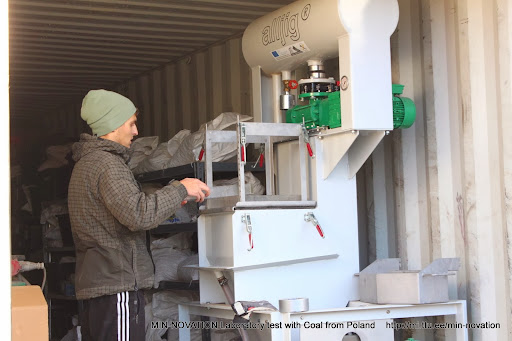
Pilot unit test: Coal Waste from Poland

Estonia pilot unit: "Waste to product"

Test: Coal waste from Poland


Pilot unit: crushing bucket and wheel loader


Coal Waste from Poland


Preparations for taking samples for sieving


Sample for sieving test


Coal waste before crushing


Crushing with crushing bucket. Result: particle size 0 to 40 mm


Coal Waste after crushing


Analyzing parameters


Analyzing parameters


Sample from crushed coal waste


Preparations for separation process


Separation process


Befor separation


After separation


After separtion process: upper layer "Coal"


After separation process: lower layer "waste rock"


--
MIN-NOVATION Mining and Mineral Processing Waste Management Innovation Network
http://mi.ttu.ee/min-novation/

SDIMI 2013 presentation "Mining waste management of Estonian mineral resources" by Veiko Karu, 02.07.2013

SDIMI 2013
6th International Conference on Sustainable Development in the Minerals Industry
30 June - 3 July 2013, Milos island, Greece

Session: Sustainable Energy and Land Use

"Mining waste management of Estonian mineral resources" by Veiko Karu
Presentation:
From SDIMI 2013, Milos, Greece

From SDIMI 2013, Milos, Greece

This research was supported by European Social Fund’s Doctoral Studies and Internationalisation Programme DoRa, which is carried out by Foundation Archimedes. - See more at: http://adm.archimedes.ee/stipendiumid/programm-dora/avalikkuse-teavitamine/#sthash.niCKfSKv.dpuf 

Possibilities of fine material removal

Summary of bachelor study on "Possibilities of fine material removal". Author: Erki Närep

Limestone is one of the most common minerals in Estonia. It is mainly used as raw material for the production of splinters and cement. The limestone bed consists of upper layers with high quality limestone and lower layers with clay-rich limestone. Producing splinters and cement with a clay-rich limestone requires additional processing, in order to reduce clay content using fine material removal.

The aim of this study was to test and evaluate three different methods for fine material removal – jigging, pressure washing and dry sieving, and research the appropriate equipment. As a reference method, washing by hand was also carried out which represented the ideal subsample. In this study, fine material is defined as material sized 0-4 mm. The clay-rich limestone sample material used in the experimental work was taken from Väo IV open cast. The sample material was first homogenized and distributed into subsamples. The subsamples were then processed using the mentioned methods. Finally, sieve analysis was carried out with the processed subsamples in order to evaluate the effectiveness of these methods.

The results showed that the most effective method is dry sieving, which removed the full percentage of fine material. Jigging removed 70% and pressure washing removed 29% of the 0-4 mm sized material. The appropriate equipment for fine material removal is McLanahan’s Rotary Scrubber, McLanahan’s Log Washer and Haver & Boecker’s Hydro Clean Washing System.


Dry sieving proved to be the most effective method. However, it is not industrially applicable due to high time expenditure and energy consumption. Pressure washing as an independent method is also not applicable due to low percentage of fine material removal. Therefore, the most effective industrially applicable method is jigging. The highest effectiveness would be achieved by combining both, jigging and high pressure washing (as additional processing), which theoretically should remove all fine material. Hydro Clean Washing System has the lowest water consumption, appropriate productivity, low upkeep, it is environment friendly and it uses the previously mentioned combined method which makes it the best choice for fine material removal today.

The best method for fine material removal on the basis of Väo IV open cast:
- Extraction with hydraulic hammer
- Preliminary crushing with jaw crusher
- Fine material removal with Hydro Clean Washing System
- Producing splinters with a crusing complex
- Processing removed fine material with CDE equipment

MIN-Novation Eesti: Agenda: "Mining Waste Management in Estonia", 16.05.2013

MIN-Novation Eesti: Päevakava: Rahvusvaheline konverents "Mining Waste Management in Estonia", 16.05.2013:

MIN-Novation Eesti: “Mining waste management in Baltic Sea Region: MIN-NOVATION project”, Piotr Szmigielski, FII

MIN-Novation Eesti: “Mining waste management in Baltic Sea Region: MIN-NOVATION project”, Piotr Szmigielski, FII:

MIN-Novation Eesti: “Financing for technology-based startups/companies, including mining waste management companies in Estonia“, Kati Nikopensius, Startup Incubator Tehnopol

MIN-Novation Eesti: “Financing for technology-based startups/companies, including mining waste management companies in Estonia“, Kati Nikopensius, Startup Incubator Tehnopol:

MIN-Novation Eesti: “Role of Environmental Board in Mineral Extraction”, Tiit Kaasik, Environmental Board

MIN-Novation Eesti: “Role of Environmental Board in Mineral Extraction”, Tiit Kaasik, Environmental Board:

MIN-Novation Eesti: “Mineral Resources of Estonia”, Tarmo All, Ministry of Environment

MIN-Novation Eesti: “Mineral Resources of Estonia”, Tarmo All, Ministry of Environment:

MIN-Novation Eesti: “Waste Management challenges in Estonia” Ulvi-Karmen Möller, Ministry of Environment

MIN-Novation Eesti: “Waste Management challenges in Estonia” Ulvi-Karmen Möller, Ministry of Environment:

MIN-Novation Eesti: “Cement production and waste management”, Riho Iskül, Kunda Nordic Cement, Heidelberg Group

MIN-Novation Eesti: “Cement production and waste management”, Riho Iskül, Kunda Nordic Cement, Heidelberg Group:

Related Posts Plugin for WordPress, Blogger...